
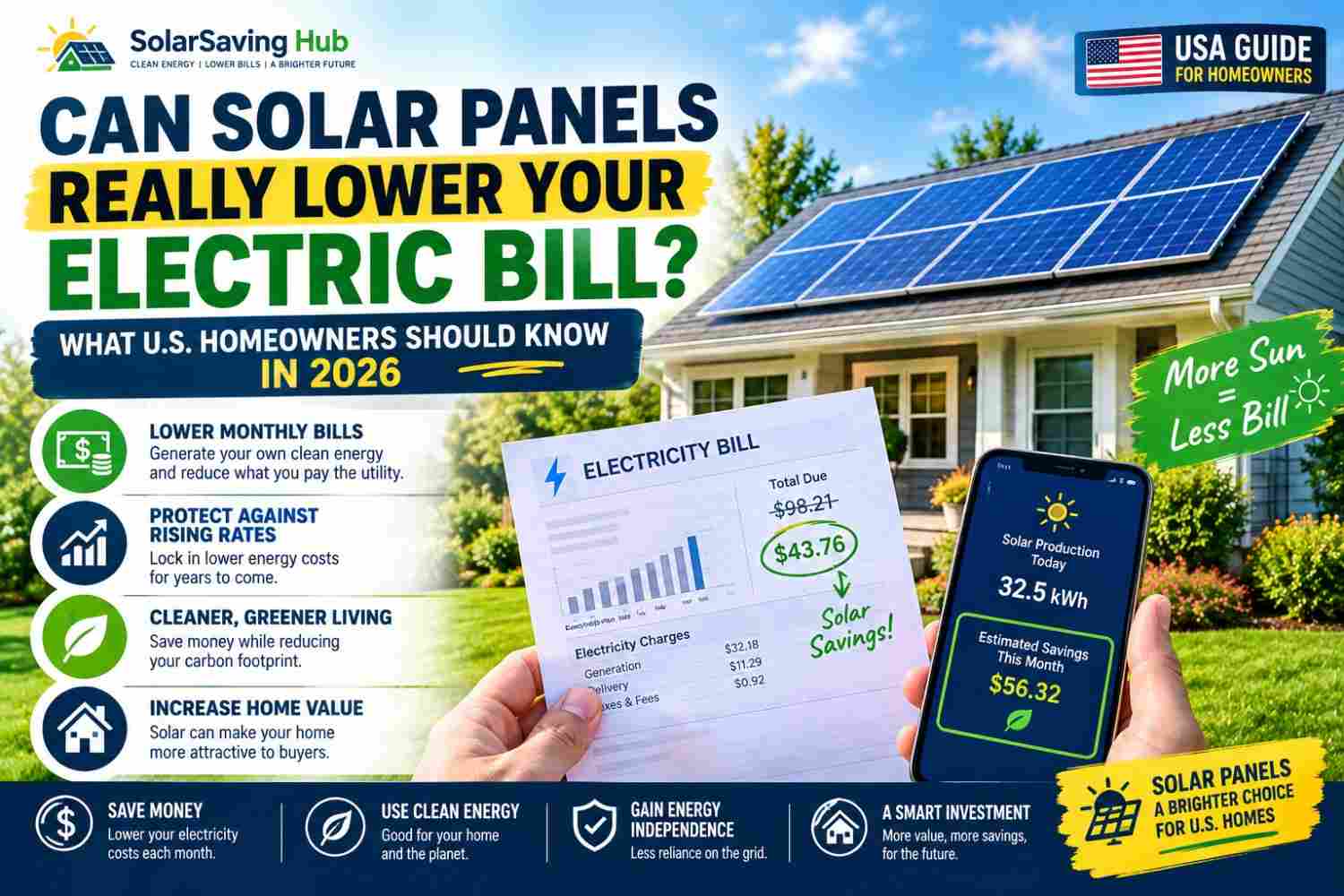
If you’re tired of watching your utility bill climb every year, you’ve probably asked yourself: can solar panels lower your electric bill in any meaningful way, or is it mostly marketing? The short answer is yes, solar panels can lower your electric bill significantly for most U.S. homeowners. This guide breaks down exactly how much solar panels lower your electric bill, why it varies so much by state, and what to expect in 2026.
Short Answer: Yes, Solar Panels Lower Your Electric Bill Significantly
On average, U.S. homeowners save around $1,500 to $1,764 per year on electricity after installing solar, which works out to roughly $115 to $170 per month for a typical 8 kW system. Over the 25 year lifespan of a system, total savings commonly land between $41,000 and $155,000, with EnergySage putting the national average closer to $60,500 over 25 years.
Most properly sized systems can offset 50% to 90% of a household’s electric bill, and in some cases, especially with net metering and battery storage, solar panels lower your electric bill close to zero.
How Much Solar Panels Lower Your Electric Bill Depends on a Few Key Factors
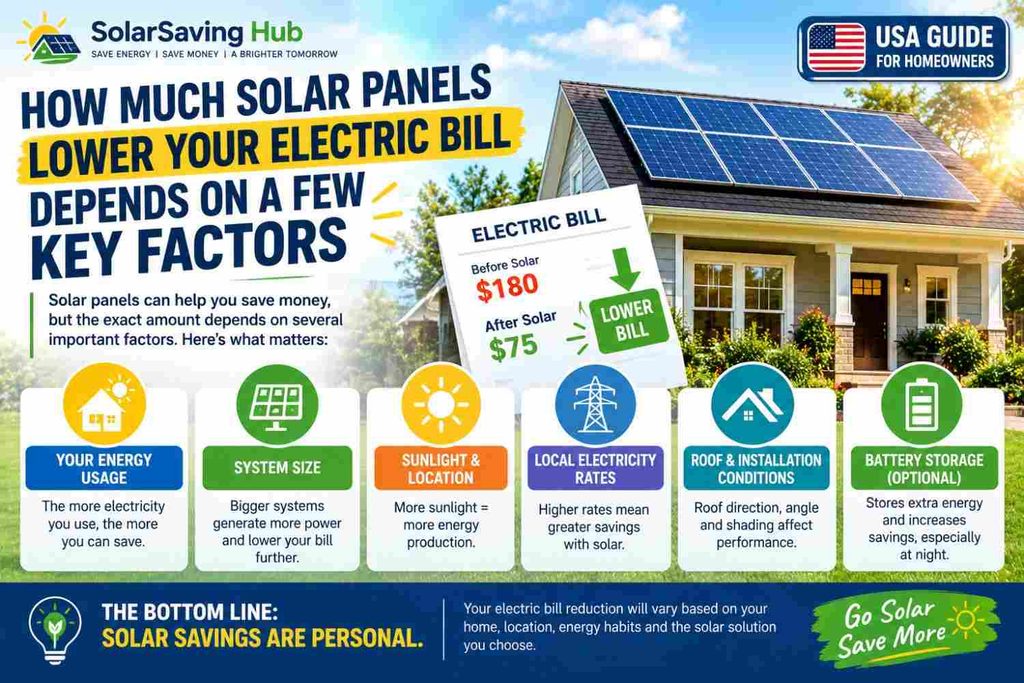
Your actual bill reduction depends on a handful of variables that can swing how much solar panels lower your electric bill:
- Local electricity rates. This is the single biggest factor in how much solar panels lower your electric bill. The more you pay per kWh, the more each kWh of solar production is worth.
- System size. A 5 kW system might save $100 to $150 a month, while a properly sized 8 to 10 kW system can lower your electric bill by considerably more.
- Household energy use. Homes with higher usage (AC heavy climates, electric heating, EV charging) tend to see larger dollar savings, since there’s more usage to offset.
- Sunlight exposure. Roof angle, shading, and regional sun hours all affect how much electricity your system actually produces.
- Net metering and export credit policies. Utilities vary widely in how much credit they give for excess solar power sent back to the grid.
- Battery storage. Batteries let you use stored solar power during expensive evening peak hours instead of buying grid electricity at higher rates, which further helps solar panels lower your electric bill.
Solar Panel Savings by State: Why the Range Is So Wide
Because electricity rates vary enormously across the U.S., so does how much solar panels lower your electric bill from state to state. Here’s a rough picture for 2026:
| State Type | Typical Monthly Savings |
|---|---|
| High rate states (Hawaii, Massachusetts) | $240 to $290 |
| National average | $115 to $170 |
| Low rate states (Louisiana, Oklahoma) | $75 to $95 |
In California, where electricity runs around 34 cents per kWh, a homeowner paying $200 to $350 a month might see solar panels lower their electric bill by $100 to $300 or more. In New York, where rates average around 22 cents per kWh, a 10 kW system can save $2,640 to $3,080 annually. Compare that to lower rate states, where the same size system saves noticeably less simply because grid electricity was cheaper to begin with.
How Long Until Solar Pays for Itself?
This is often called the “payback period,” the time it takes for your electricity savings to equal what you spent on the system. In 2026, the national average payback period is 8 to 10 years. It varies by state:
- Massachusetts: roughly 6 to 7 years, one of the fastest places for solar panels to lower your electric bill enough to cover costs
- California: roughly 7 years
- Lower rate states: 11 to 14 years
After that payback point, your electricity is essentially free for the remaining life of the system, meaning solar panels lower your electric bill for years with no added cost, since the system is typically warrantied for 25 years or more.
A 2026 Update: No More Federal Tax Credit
If your savings math is based on older articles, it’s worth knowing that the 30% federal residential solar tax credit (Section 25D) expired on December 31, 2025. Homeowners who buy a system with cash or a loan in 2026 no longer receive this credit. The one exception: if a system was placed in service in 2025, that credit still applies on the 2025 tax return.
Solar leases and Power Purchase Agreements (PPAs) work differently. Under Section 48E, the financing company can still claim a federal credit through 2027 and may pass some of that savings on to you through a lower monthly payment, even though you won’t own the system outright.
State, local, and utility level incentives (rebates, tax exemptions, and net metering programs) are still widely available and can meaningfully improve how much solar panels lower your electric bill, so it’s worth checking what’s offered where you live.
Does Solar Eliminate Your Electric Bill Completely?
Not always, and it’s important to set realistic expectations about how much solar panels lower your electric bill. Even with a well sized system, most homeowners will still see a small utility bill due to:
- Fixed monthly charges utilities apply regardless of how much power you use
- Minimum usage charges in some markets
- Time of use rates, where nighttime or off peak electricity from the grid may cost more than what your exported solar earns in credit
- Seasonal production changes, since panels generate less in winter months
Pairing solar with a battery can help solar panels lower your electric bill even further by letting you store and use your own power during expensive peak hours rather than pulling from the grid.
Real Homeowner Scenario: How Solar Panels Lower Your Electric Bill
Picture a household paying $180 a month for electricity in a moderate rate state. After installing a properly sized 7 kW system, solar panels lower their electric bill to around $40 to $60 a month, mostly made up of fixed utility charges. Over a year, that’s roughly $1,500 in savings, right in line with the national average. This kind of example shows how solar panels lower your electric bill in practice, not just on paper.
Should You Size Your System for Future Needs?
If you’re planning to add an electric vehicle, a heat pump, or a whole home battery down the road, it’s often smarter to size your system a bit larger now so solar panels lower your electric bill by a wider margin as your usage grows. Installing more capacity upfront typically comes at a lower cost per watt than adding panels later, and EV charging alone can add 3,000 to 4,500 kWh of annual electricity demand. A system oversized by 10 to 15% relative to your current usage tends to be a smart move if bigger electricity needs are on the horizon.
Key Takeaways
- Solar panels can lower your electric bill by 50% to 90% in most homes, with average annual savings of $1,500 or more.
- Over a 25 year system life, total savings commonly range from $41,000 to $155,000, depending on location and system size.
- Electricity rates matter most. High rate states like Hawaii, Massachusetts, and California see the biggest dollar savings.
- The typical payback period is 8 to 10 years nationally, faster in high rate states.
- The federal 25D tax credit expired at the end of 2025, so 2026 cash and loan purchases no longer get that 30% credit, though state and local incentives, plus lease and PPA options, are still available.
- Fixed utility charges and seasonal production mean solar panels lower your electric bill significantly rather than eliminate it entirely, unless paired with a well sized battery.
So, can solar panels lower your electric bill in 2026? For the vast majority of U.S. homeowners, the answer is a clear yes, and with rates continuing to rise nationwide, the savings only tend to grow larger over time.
Frequently Asked Questions
Do solar panels lower your electric bill in every state? Yes, in almost every case solar panels lower your electric bill to some degree, though the exact savings depend heavily on your local electricity rate and how much sun your roof gets.
How fast can solar panels lower your electric bill after installation? Most homeowners see solar panels lower their electric bill starting with the very first billing cycle after the system is turned on and connected to the grid.
Can solar panels lower your electric bill to zero? In some cases, especially with a well sized system paired with battery storage and favorable net metering, solar panels can lower your electric bill close to zero, though fixed utility charges usually still apply.
Savings figures above reflect national averages and 2026 industry data. Your actual electric bill reduction depends on your local utility rates, system size, home energy use, and available incentives. A personalized solar quote is the most reliable way to estimate your specific savings.