
It’s one of the most common misconceptions in the solar industry: “I have solar panels on my roof, so if the neighborhood loses power, my lights will stay on.” For most homeowners, that assumption is wrong, and finding out the hard way, in the middle of a blackout, is a frustrating surprise. Here’s what’s actually happening, and how to fix it.
The Short Answer
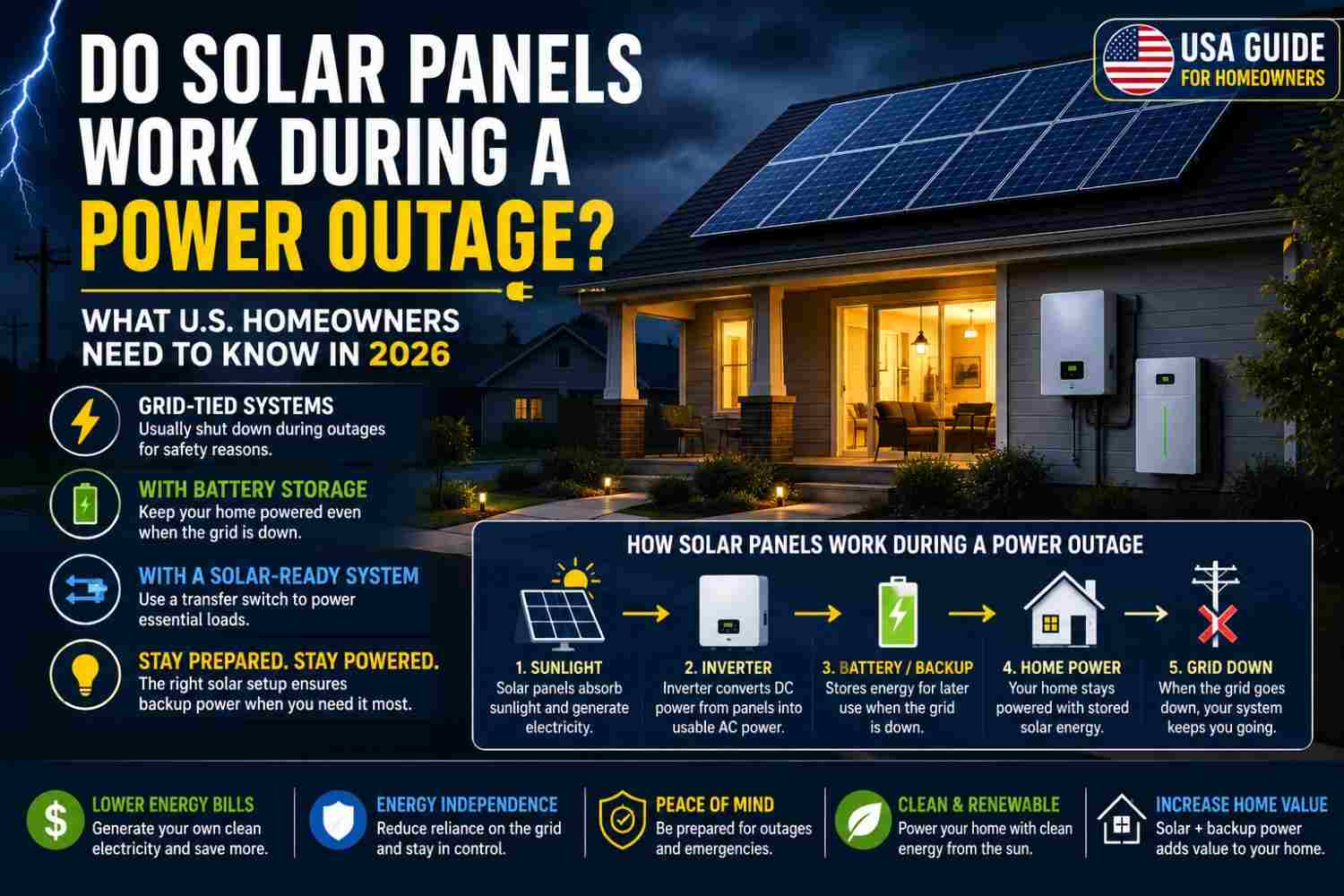
No, standard solar panels do not work during a power outage, even in full, direct sunlight. If your system is “grid tied” (the most common setup, and required for net metering), your solar inverter automatically shuts off the moment the grid goes down. The panels themselves keep generating electricity, but that power has no approved path into your home.
The only way to keep solar power flowing during a blackout is with added backup equipment, typically a battery, a hybrid inverter, and a transfer switch.
Why Do Solar Panels Shut Off During an Outage?
This isn’t a malfunction, it’s a required safety feature. Here’s what’s going on:
Sunlight still hits your panels, and the cells still produce DC electricity. But federal safety standards require grid tied solar inverters to shut down automatically during a utility outage. This is called anti islanding protection, and it exists for one critical reason: to protect utility lineworkers.
If your system kept feeding electricity into the grid while crews were working to restore power, it could “backfeed” electricity into lines that workers assume are dead, creating a serious electrocution risk. So by design, your inverter cuts off production the instant it detects the grid has gone down, regardless of how sunny it is outside.
This applies to every grid tied system, new or old, small or large, unless it has been specifically designed with backup capability.
How to Keep Your Solar Panels Working During an Outage
The good news: with the right setup, your solar system absolutely can power your home during a blackout. Here’s what that setup looks like.
1. Add a Solar Battery
A battery (like a Tesla Powerwall or Enphase IQ Battery) stores excess solar energy so it’s available even when the grid is down. This is the foundation of any solar backup system.
2. Install a Hybrid Inverter or Automatic Transfer Switch
This is the piece that makes backup power possible. When the grid fails, a transfer switch (sometimes called a “gateway”) physically disconnects your home from the utility grid. Your inverter then recognizes the battery as a safe, isolated power source and starts generating again, powering your home as its own small “microgrid” without sending anything back onto the grid.
3. Understand What Your Battery Can (and Can’t) Run
A home battery is built to cover essentials, not your whole house at full capacity. As a rough guide:
- A common 10 kWh battery can run basic household loads for roughly 8 to 12 hours.
- Turn on power hungry appliances like central AC, and that runtime can drop to 3 to 4 hours.
- Solar panels recharge the battery as soon as the sun comes up, so a multi day outage looks very different with solar plus battery than it does when you’re rationing generator fuel.
Most homeowners set their system up to prioritize critical circuits, such as the refrigerator, WiFi router, some lighting, and medical equipment, rather than trying to run everything at once.
A New Option in 2026: Sunlight Backup (No Battery Required)
One development worth knowing about: some advanced inverters now offer a feature sometimes called “Sunlight Backup.” This allows solar panels to power a few critical circuits, like a refrigerator or router, directly during an outage, without a battery, as long as the sun is shining brightly.
The catch: it’s weather dependent. If a cloud passes overhead, output drops immediately, and whatever you’re powering can shut off. It’s a helpful stopgap, but it’s not a substitute for a proper battery backup system if reliable power matters to you.
Solar Battery vs. Generator: Which Is Better for Outages?
Many homeowners pair the two rather than choosing one exclusively:
| Solar Battery | Standby Generator | |
|---|---|---|
| Recharges from sunlight | Yes | No (needs fuel) |
| Runs silently | Yes | No |
| Good for short outages | Yes | Yes |
| Good for extended outages | Yes, if sized well | Limited by fuel supply |
| Typical cost | Adds $7,000 to $18,000 to a solar system | $3,000 to $10,000 (whole home units) |
A generator can be a useful backstop for a long outage once a battery runs low, especially in regions where extended multi day blackouts are common.
Why This Matters More in 2026
Weather related power outages have been trending upward for years. Roughly 80% of major U.S. outages between 2000 and 2023 were weather related. With solar installations now numbering in the millions across American rooftops, more homeowners than ever are discovering this gap between “I have solar” and “I have backup power,” often at the worst possible moment.
If keeping the lights on during a blackout is a priority for you, it’s worth discussing backup ready equipment (battery, hybrid inverter, transfer switch) directly with your installer before your system is installed, since retrofitting later is possible but often costs more.
Key Takeaways
- Standard grid tied solar panels shut off during outages. This is a required safety feature (anti islanding), not a defect.
- The shutoff protects utility lineworkers from being electrocuted by backfed electricity.
- To get power during a blackout, you need a battery, hybrid inverter, and transfer switch, not just panels.
- A typical 10 kWh battery covers essentials for roughly 8 to 12 hours, less if you run high draw appliances.
- Newer inverters offer limited “sunlight backup” for a few circuits, but it’s weather dependent and not a full solution.
- Ask your installer about backup ready equipment during the initial design, not after the fact.
This guide reflects general 2026 industry information. Your specific backup capability depends on your system’s equipment, battery size, and how your installer configures it. Always confirm outage readiness details with your installer before you sign a contract.